When government case work outgrows the project tool
Why government agencies move case work off generic project and work-management tools, and what a defensible case record actually requires.
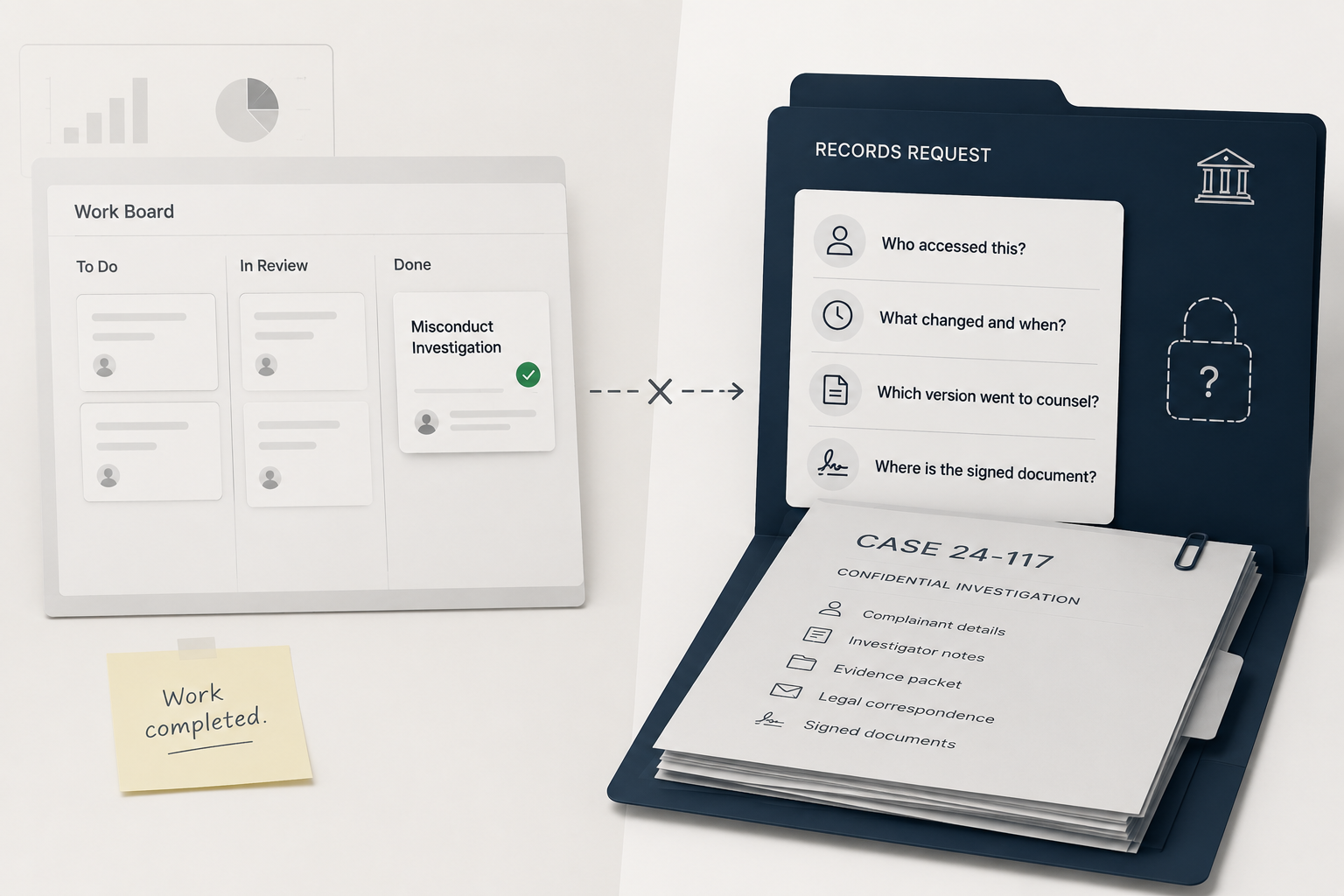
An inspector general’s office runs a misconduct investigation for nine months across a work-management board, a shared drive, and a thread of approval emails. The finding is sound. Then a records request lands, and someone has to prove who saw the complainant’s name, when the respondent was notified, and which version of the evidence packet went to counsel. The board shows tasks moved from “In Review” to “Done.” It does not show any of that. The work happened; the record of the work did not.
Generic work and project tools are built to move tasks forward. Government case work is judged by the record it leaves behind. Those are not the same product, and the gap only shows up at the moment it is most expensive to discover.
The dashboard is not the deliverable
A lot of public-sector teams land on a project or work-management platform for case work because it is already in the building. It tracks tasks, it sends reminders, it shows a tidy board to leadership. For coordinating a policy rollout or a procurement cycle, that is genuinely the right tool. The category sells itself on exactly that: convert goals into action, coordinate across divisions, respond to change with clarity. All true.
Case work is a different animal. Take an ethics complaint, a benefits-fraud referral, or a licensing investigation: the unit of work is a case record, and that record has to survive scrutiny long after the work is done. The question an auditor or a records officer asks is never “did the task get marked complete.” It is “show me the trail.” Who accessed this case. What changed, when, and by whom. Where the signed document is and who signed it. A board optimized for throughput has no native answer to any of that, because it was never the question the tool was designed around.
This is the quiet mismatch. The tool is doing its job well. The job is just not the one the agency is accountable for.
What a defensible case record actually requires
Strip the marketing language away and a government case record has to do three things that a project tool does as an afterthought, if at all.
It has to attribute everything, by default. Not an activity feed you can turn on, but a full audit trail, capturing timestamp, user, source, and action, written for every change whether anyone is watching or not. The distinction matters because the value of an audit trail is precisely that no one decided to start keeping it. It already exists when the records request arrives. Bolt-on logging that an admin enabled in month four leaves a gap exactly where the question will land.
It has to control who sees what at the record and field level. A confidential investigation cannot live on a board where visibility is “everyone on the project.” The complainant’s identity, the respondent’s HR history, the investigator’s working notes: these need row-level security that restricts a case by role or assignment, and field-level security that hides specific fields even from people who can see the case. Project tools share by project or workspace. That granularity is the wrong shape for case work, and re-creating it with duplicate boards and manual permissions is how leaks happen.
It has to keep the documents inside the record. The moment evidence lives in a separate drive and signatures happen in a separate signing tool, chain of custody becomes a reconstruction project. A defensible case keeps the document workflow inline: versioning, full-text search, a signature round-trip where the envelope state, signer identity, timestamps, and routing history come back attached to the case itself. It applies sequential page-level numbering, or Bates numbering, to the compiled packet so the set you hand to counsel or a regulator is export-ready and internally consistent. None of this is exotic. It is just structurally absent from a tool built around tasks.
When those three things are native, the record is the byproduct of doing the work. When they are not, the record is a second job you do after the work, under deadline, from memory and scattered systems. That second job is where defensible cases go to die.
”Audit-ready” is a claim you have to be able to back
There is a credibility trap worth naming, because government buyers walk into it constantly. Vendors selling into the public sector reach for certification language, and the strongest-sounding words are often the ones a tool cannot actually stand behind.
Be precise about the difference between a security practice and a security certification. CJIS-aligned security practices, meaning encryption, access control, attribution, and an on-premises deployment option for criminal-justice workloads, are something a product either implements or does not, and you can verify it. “CJIS-certified” or “FedRAMP authorized” are formal authorizations that require a completed audit against a specific baseline. A tool that has done the practice but not the audit should say the first thing and not the second. As a buyer, the cleaner read is to ask which it is, every time, and to treat a vendor that blurs the line as a vendor whose other claims also need checking.
The same discipline applies to your own output. An audit trail is defensible language. “Court-admissible” is a legal conclusion that depends on jurisdiction and how the record was handled, not a feature you can buy. The agencies that survive scrutiny are the ones that under-claim and over-document, not the reverse.
The honest tradeoff
This is not an argument that every agency should rip out its work-management platform. If your team’s public-sector work is genuinely coordination, things like capital projects, cross-agency planning, community engagement, or getting a hundred people aligned on a rollout, then a project tool is the right tool and a case-management system is overkill you will resent. Case management earns its place when the work is adjudicative: investigations, complaints, benefits and licensing determinations, anything where the record is the deliverable and someone external will eventually read it.
The mistake is not choosing one over the other. The mistake is running case work on a coordination tool because it was already there, and only finding out the record cannot support the work when a request forces the question. By then the gap is historical and unfixable.
Where this leaves a public-sector team
The decision is simpler than the vendor noise around it suggests. Ask what your work is judged by. If it is whether the project moved forward, you already have the tool for that. If it is whether the record holds up to an inspector general, a records request, or an appeal, then the audit trail, the field-level controls, and the document chain of custody are not features to compare on a grid. They are the product, and they need to be native, not enabled.
Avikto is built for the second case: case management software for government agencies where attribution, row-level and field-level security, an inline document and signature workflow, and configurable audit-log retention are how the system works by default, not options you remember to switch on. Professional is $499 per month with unlimited users. That covers the whole investigative or program office, with no per-seat tax that pushes you toward sharing logins and losing attribution.
If you are running case work on a board today, skip the feature demo you will never check against. Take one real case type, your most scrutinized one, and walk through what the record would look like in a system designed around it.